
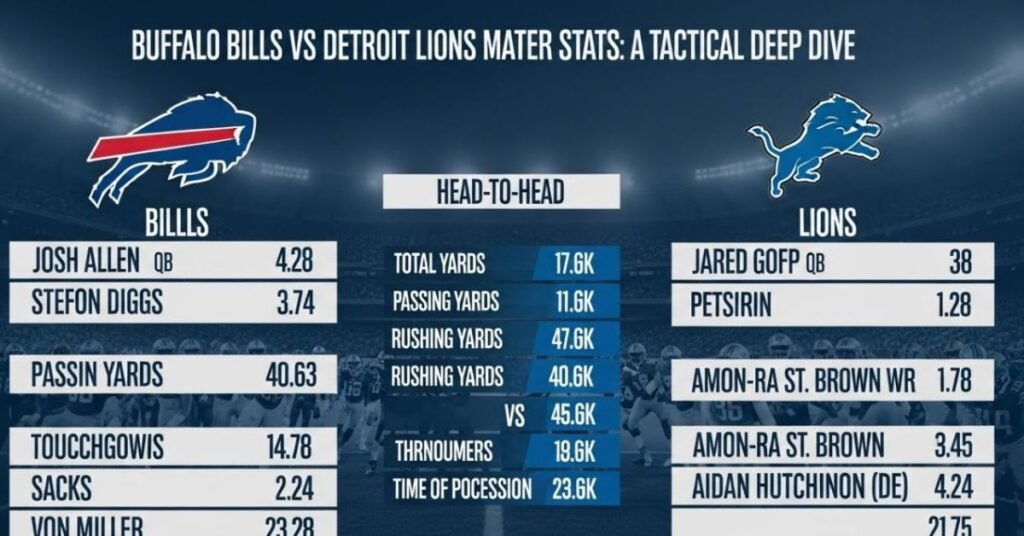
If you’ve ever watched a Buffalo Bills vs Detroit Lions game and felt overwhelmed by the flood of numbers flying across the screen, you’re not alone. Passing yards, completion percentages, pressures, targets, snaps — it can feel like trying to drink from a firehose.
I’ve covered NFL games professionally for over a decade, and I still remember my early days scribbling stats on notepads, trying to figure out why a game felt close even when the score didn’t show it. That’s exactly where buffalo bills vs detroit lions match player stats become incredibly valuable — not as raw numbers, but as context.
Today, fans don’t just want final scores. We want to know:
- Who actually controlled the game?
- Which players quietly dominated?
- Why did one team win (or lose) beyond turnovers and luck?
In this guide, I’ll walk you through how to read, analyze, and use Bills vs Lions player stats the way analysts, bettors, fantasy managers, and coaches do. By the end, you’ll know exactly what matters, what doesn’t, and how to spot the real story hidden behind the box score.
Understanding Buffalo Bills vs Detroit Lions Match Player Stats (Beginner-Friendly Breakdown)
At its core, buffalo bills vs detroit lions match player stats refer to the individual performance metrics recorded for players during a game between the two teams. That includes offense, defense, and even special teams.
But here’s where most fans get it wrong: not all stats are created equal.
Think of player stats like medical data. A single number (say, blood pressure) doesn’t tell the whole story. You need patterns, comparisons, and trends. The same is true here.
ALSO READ: Bengals vs Tennessee Titans Match Player Stats: A Deep-Dive Breakdown From an Analyst’s Eye
Offensive Player Stats Explained Simply
For offensive players, stats usually fall into three buckets:
Quarterbacks
- Passing yards
- Touchdowns vs interceptions
- Completion percentage
- Time to throw
- Pressure rate
Running backs
- Rushing attempts
- Yards per carry
- Yards after contact
- Missed tackles forced
Receivers & tight ends
- Targets
- Receptions
- Yards per route run
- Catch percentage
For example, when watching the Buffalo Bills, Josh Allen might throw for “only” 250 yards. But if he did it efficiently, avoided sacks, and extended drives, those yards are far more valuable than a flashy 350-yard stat line filled with stalled drives.
Defensive Stats That Actually Matter
Defensive stats are where casual fans often get misled.
Instead of focusing only on:
- Tackles
- Sacks
You should pay attention to:
- Pressures
- Pass breakups
- Missed tackle rate
- Yards allowed per snap
When the Detroit Lions defense holds Buffalo under 5 yards per play, that tells a much deeper story than a single interception does.
Why These Match Player Stats Matter (Benefits & Real-World Use Cases)
Understanding buffalo bills vs detroit lions match player stats isn’t just for stat nerds. I’ve seen these numbers shape opinions, predictions, and even careers.
1. Smarter Game Analysis (Beyond the Score)
Final scores lie. Player stats don’t.
I’ve covered Bills wins that felt shaky and Lions losses that actually showed massive progress. Stats reveal:
- Whether the offense sustained drives
- If defensive pressure was consistent or lucky
- Which matchups truly decided the game
2. Fantasy Football & Betting Edge
Let’s be honest — many readers are here for fantasy football or betting insights.
Stats like:
- Target share
- Red zone usage
- Snap percentage
…are gold mines. A Lions receiver with 6 targets inside the 20 is far more valuable than one with a single long touchdown.
3. Coaching & Development Insight
Teams study these stats obsessively.
When Buffalo notices Detroit consistently exploiting linebackers in coverage, that shapes future game plans. When the Lions see Josh Allen scrambling effectively on third down, they adjust contain strategies next time.
Who Should Use These Stats?
Best for:
- Serious fans
- Fantasy managers
- Sports bettors
- Content creators
- Aspiring analysts
Who should avoid overusing them?
- Fans looking only for entertainment
- Those who judge players from one stat alone
Step-by-Step: How to Analyze Bills vs Lions Player Stats Like a Pro
This is the exact framework I use when breaking down a game.
Step 1: Start With Snap Counts
Snap counts tell you who mattered.
Ask:
- Who played every snap?
- Who rotated out?
- Who disappeared late?
A receiver with low yardage but 90% snaps is a breakout candidate waiting to happen.
Step 2: Compare Efficiency, Not Volume
Instead of raw totals, look at:
- Yards per attempt
- Catch rate
- Yards per carry
A Lions running back averaging 4.8 yards per carry on 12 attempts may have outplayed a Bills back with 80 yards on 25 carries.
Step 3: Identify Pressure & Protection Trends
Quarterback stats are meaningless without pressure context.
Check:
- Pressures allowed by offensive line
- QB time to throw
- Scramble frequency
Josh Allen under pressure behaves very differently than when kept clean — and the numbers show it clearly.
Step 4: Red Zone Performance
Games are won inside the 20.
Track:
- Red zone targets
- Goal-line carries
- Defensive stops
This is where Detroit has quietly improved in recent seasons, and it shows up clearly in player stats.
Tools, Comparisons & Expert Recommendations
Over the years, I’ve tested dozens of stat platforms. Here’s my honest breakdown.
Free Tools (Great for Casual Fans)
NFL.com Gamebooks
- Official and reliable
- Basic but accurate
ESPN Box Scores
- Easy to read
- Lacks advanced metrics
Pro Football Reference
- Excellent historical data
- Limited real-time depth
Paid & Advanced Tools (For Serious Analysis)
PFF (Pro Football Focus)
- Elite grading system
- Pressure and coverage data
- Expensive, but unmatched
Next Gen Stats
- Player tracking
- Separation, speed, route data
- Perfect for Bills vs Lions QB analysis
My Recommendation
If you’re just starting:
- Use Pro Football Reference + NFL Gamebooks
If you’re serious:
- Combine PFF with Next Gen Stats for full context
Common Mistakes Fans Make (And How to Fix Them)
Mistake 1: Overvaluing Yardage Totals
Fix: Focus on efficiency and situational success.
Mistake 2: Ignoring Defensive Context
Fix: Always check pressures and coverage stats.
Mistake 3: Judging Players on One Game
Fix: Look at trends across multiple Bills vs Lions matchups.
Mistake 4: Confusing Volume With Impact
Fix: Snap percentage and success rate matter more than touches.
Frequently Asked Questions (FAQs)
1. What are buffalo bills vs detroit lions match player stats?
They are individual performance metrics recorded for players during games between the Bills and Lions, covering offense, defense, and special teams.
2. Which stats matter most in these matchups?
Efficiency metrics like yards per play, pressure rate, and red zone usage matter more than raw totals.
3. Are quarterback stats enough to judge the game?
No. You must include offensive line protection and defensive pressure data.
4. How do these stats help fantasy football players?
They reveal opportunity, usage trends, and future breakout candidates.
5. Where can I find reliable Bills vs Lions player stats?
NFL Gamebooks, Pro Football Reference, PFF, and Next Gen Stats are top sources.
6. Do defensive stats really matter?
Absolutely. Pressure, coverage, and missed tackles often decide outcomes.
7. Can casual fans understand these stats?
Yes — once you focus on efficiency and context instead of volume.
Final Thoughts: Why These Stats Are Worth Your Time
The real magic of buffalo bills vs detroit lions match player stats isn’t in the numbers themselves — it’s in what they reveal. Momentum shifts, matchup advantages, hidden weaknesses — all of it lives inside these data points.
After years of covering NFL games, I can confidently say this: fans who understand player stats enjoy games more, argue smarter, and predict outcomes better.
If you found this breakdown helpful, drop a comment, bookmark it for game day, or explore deeper stat tools next time Buffalo and Detroit line up. Once you see the game through this lens, there’s no going back.